Todoist is a task manager for organizing tasks, projects, and deadlines, on your own or with a team.
It can be connected to Agen.co two ways, matching the Official / In-house filter in the connector picker:
- Official — Agen.co connects through Todoist's own hosted MCP server. Each user authorizes with their own Todoist account, and no app needs to be registered in Todoist.
- In-house — Agen.co wraps the Todoist REST API directly through its own integration layer, using an OAuth app you register in the Todoist App Management Console, with the scopes you choose.
Pick Official if the built-in MCP tools cover what your agents need. Fall back to In-house if you want your own OAuth app or a different scope set, such as data:read only.
Prerequisites
Prerequisites
- A Todoist account. No app needs to be registered in the Todoist App Management Console — the MCP server registers Agen.co as a client automatically, so there is no Client ID or Client Secret to copy.
In the Agen.co portal, go to Connectors → My connectors and click Add connector.
In the Select connector drawer, search for
Todoistand select it. The Add Todoist panel opens with Official selected at the top.Fill in the field:
Field Required Description Instance Slug Yes Prefixes each imported tool as slug__tool, so several instances of the connector can coexist. Prefilled withtodoist. Use lowercase kebab-case. You can change it later from the connector's settings.Click Connect. Todoist opens in a new tab, and the panel shows Waiting for authorization — complete it in the opened tab…
In the Todoist tab, log in if prompted and approve the access request. Agen.co requests the
data:read_writescope, which lets it read your Todoist data and create, edit, and complete tasks and projects.Back in Agen.co, the panel switches to Select the tools to import from Todoist. Every tool is toggled on; turn off any you don't want to import, then click Add.
The connector is created and its tools imported only when you click Add. If you close the panel before that, nothing is saved, even though the Todoist tab reported success.
Adding the connector doesn't authorize anyone's tool calls yet. The first time each user's agent calls a Todoist tool, the call returns an authorization link instead of a result. The user opens the link, logs in to Todoist, and clicks Allow access. The consent screen names the requesting client by a technical ID, mcp-gateway:source:<uuid> is requesting access, rather than Agen.co — this is expected, so tell users to allow it rather than deny it. After that, the user's tool calls run with their own Todoist account. Each user can review or revoke that access later in Todoist under Settings → Integrations.
Once connected, Todoist appears under My connectors with tools spanning:
| Area | What it covers |
|---|---|
| Tasks | Finding, adding, updating, completing, reopening, rescheduling, and assigning tasks |
| Projects and sections | Creating, updating, moving, and reordering projects and sections, and importing or exporting project templates |
| Labels and filters | Finding, adding, and updating labels and filters |
| Comments and reminders | Reading, adding, and updating comments and reminders |
| Search | Searching and fetching tasks, projects, and other objects, and viewing attachments |
| Deletion | Deleting projects, sections, tasks, comments, labels, filters, and reminders. A workspace project must be archived before it can be deleted |
| Activity and insights | Activity history, productivity stats, and project and workspace health |
| Workspaces | Listing workspaces and project collaborators, and reading the user's profile |
Enabling the Todoist connector isn't enough on its own. Tool calls remain denied until you create a policy that grants access to the specific tools you want to expose.
Integrating Todoist with Frontegg allows your application to access and manage tasks, projects, sections, and comments on behalf of your users through OAuth 2.0 authentication, using the Todoist API v1.
Prerequisites
Prerequisites
- A Todoist account
- Access to the Todoist App Management Console
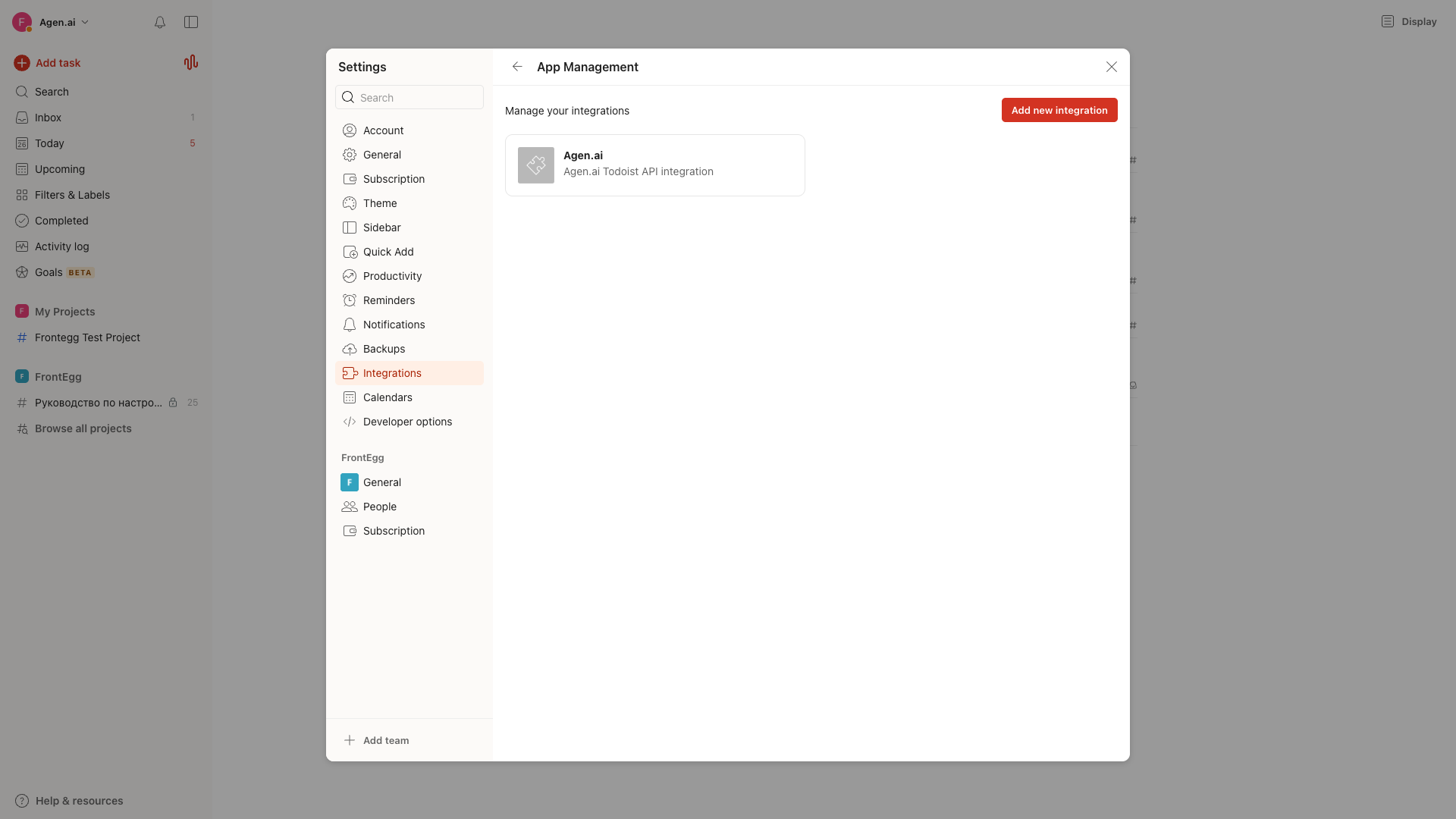
Log in to your Todoist account. Navigate to Settings → Integrations → Developer and click Manage your existing integrations. This opens the App Management page. Click the Add new integration button to create a new OAuth application.
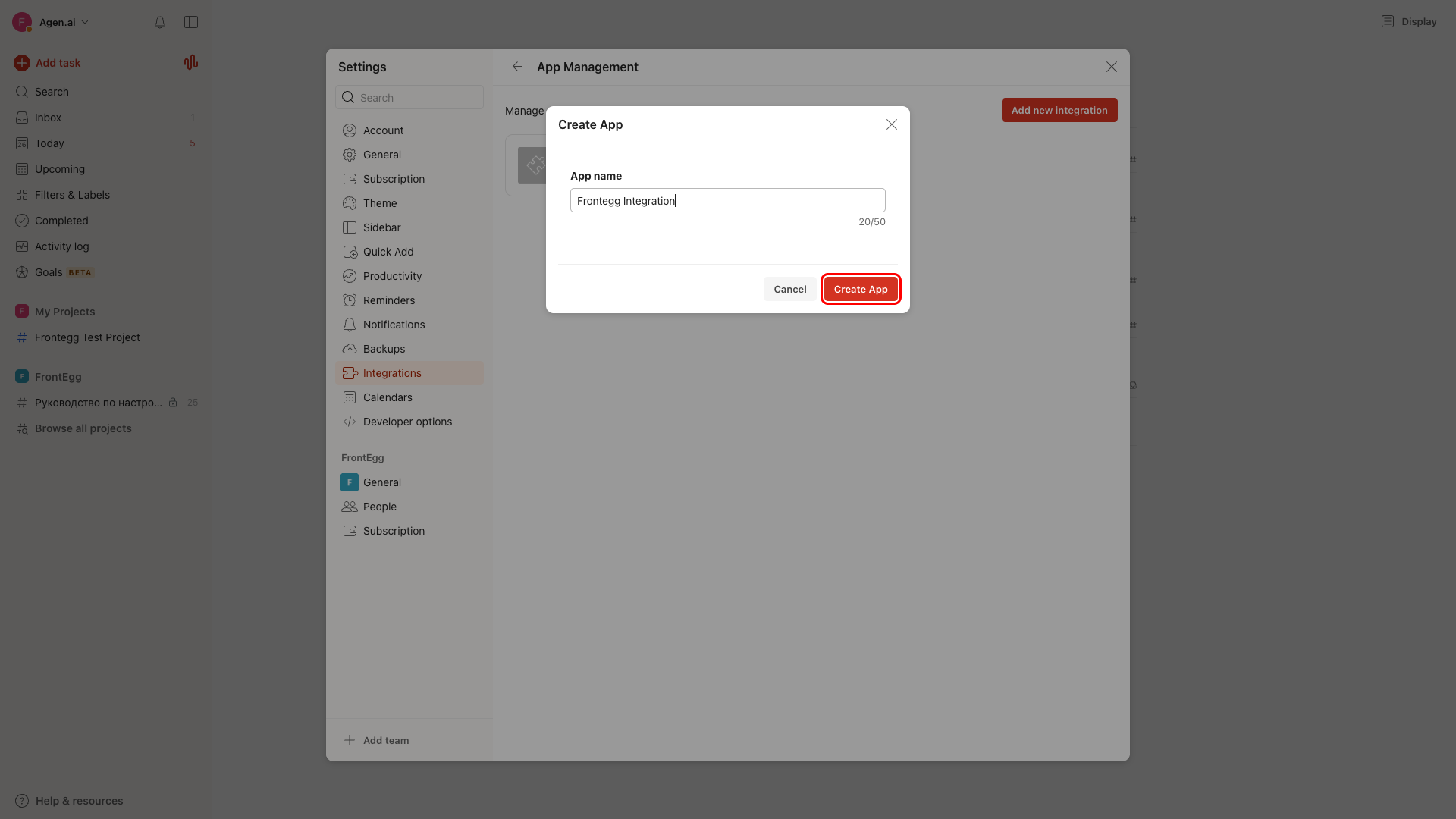
In the Create App dialog, enter a name for your application (e.g., "Frontegg Integration") and click Create App.
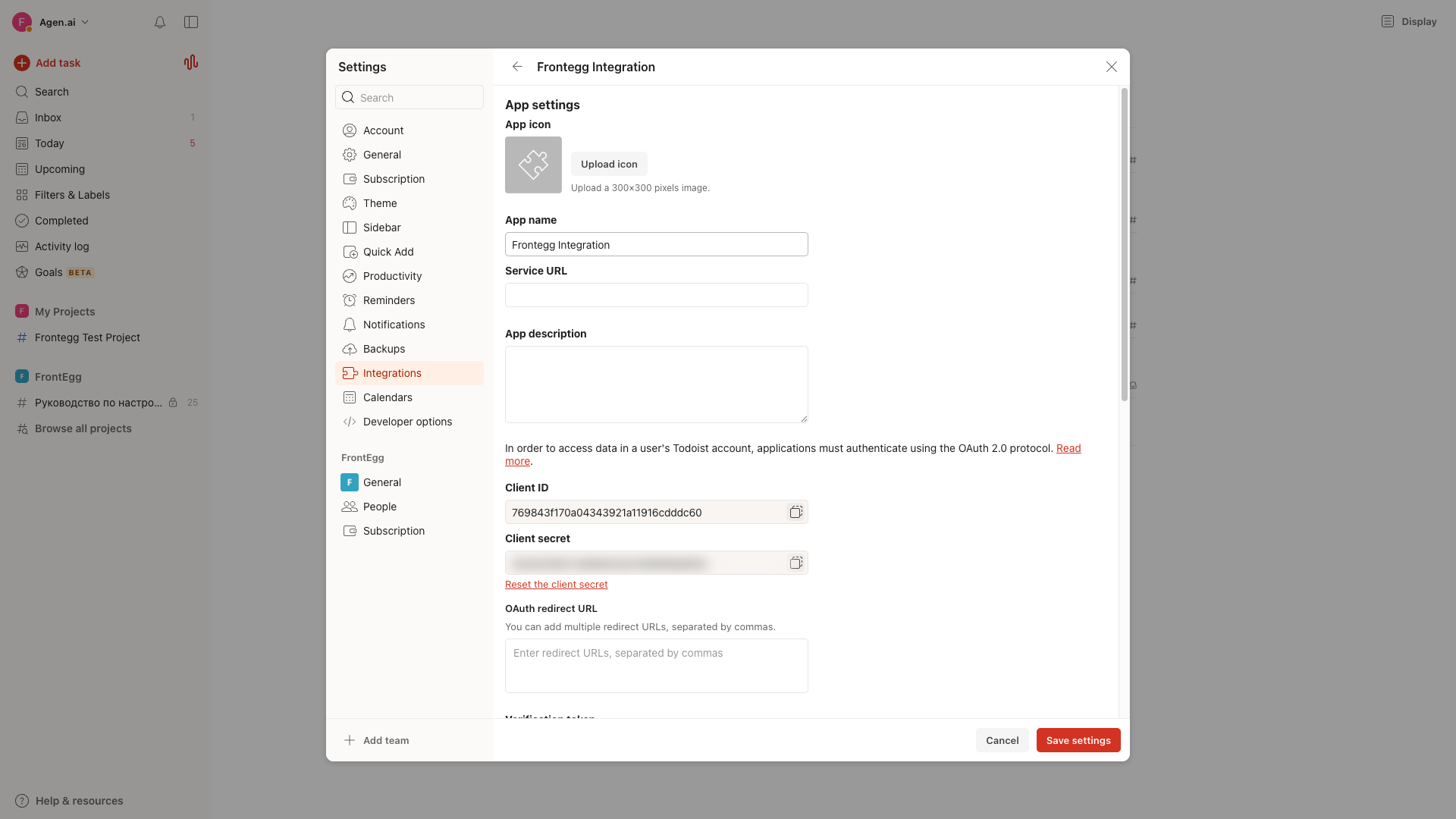
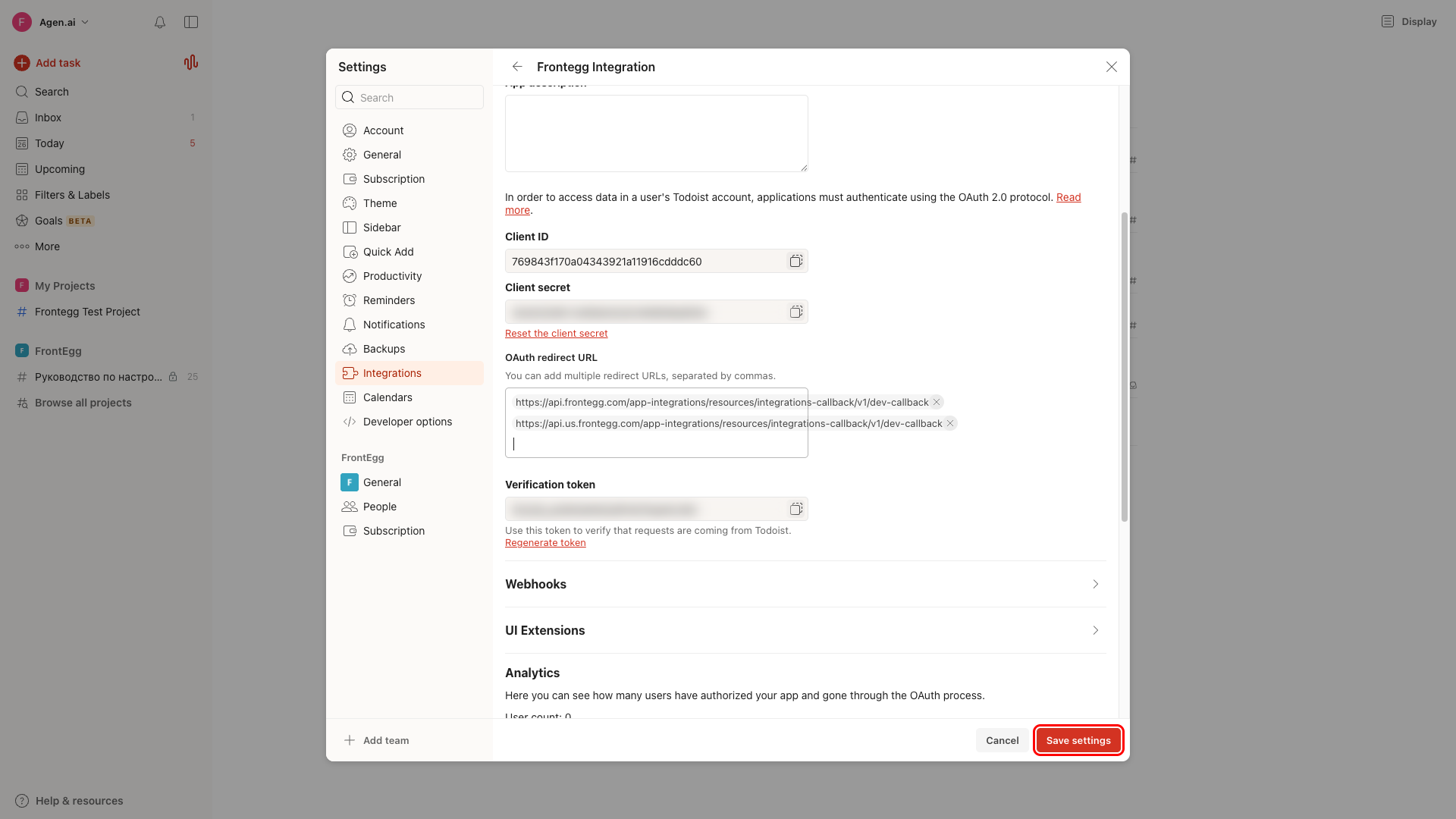
After creating the app, you are redirected to the App settings page. Here you can find your Client ID and Client Secret under the OAuth credentials section.
Copy the Client ID and Client Secret values. You will need them to configure the integration in the Frontegg portal.
Keep your credentials secure
Keep your credentials secure
Never share or commit your Client Secret to version control.
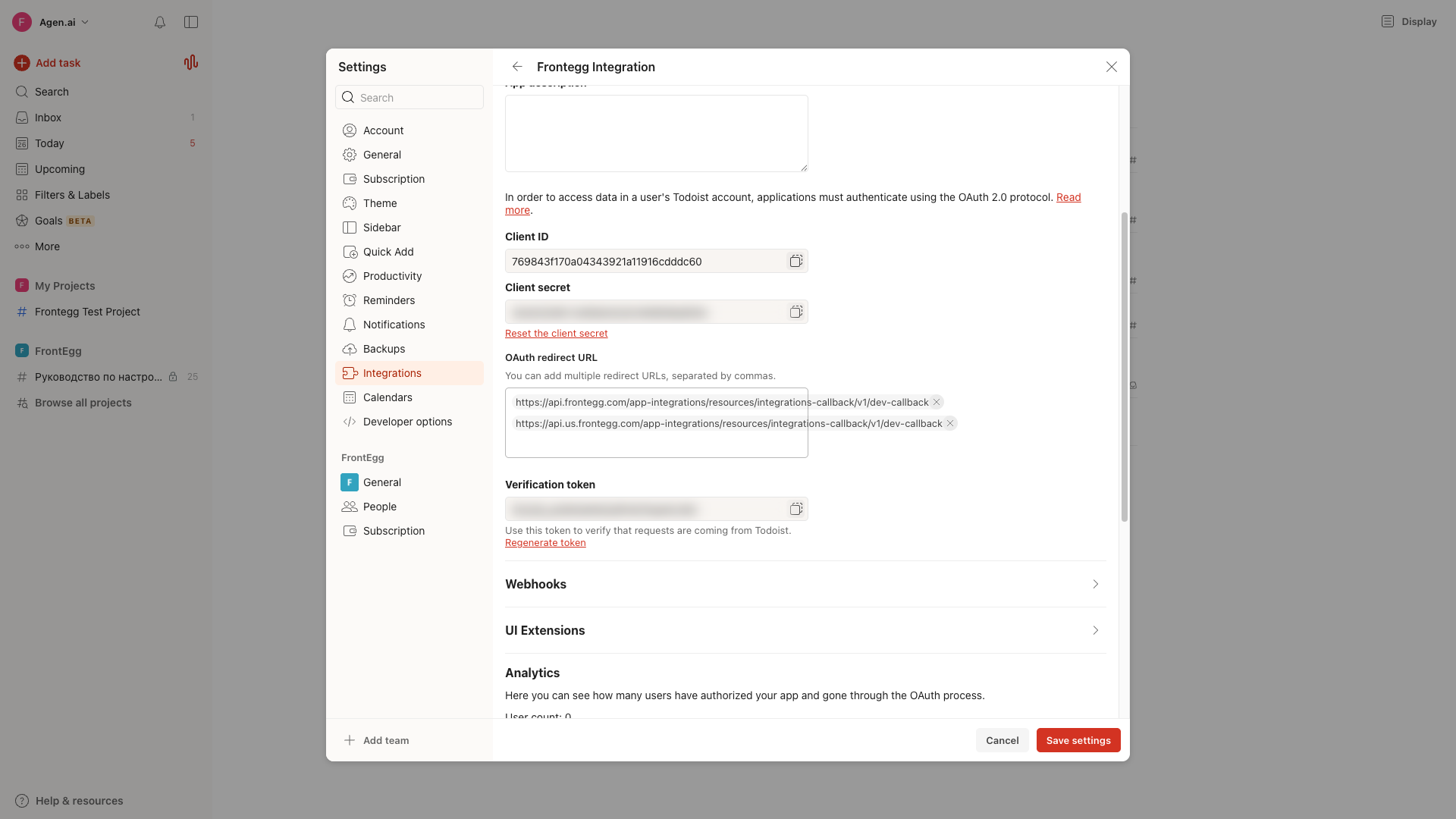
Scroll down to the OAuth redirect URL field and enter the redirect URL shown in the Frontegg portal for this integration. See How to get your Redirect URL. The value has this shape, but take the real one from the portal rather than assembling it:
https://YOUR_MCP_GATEWAY_URL/integration-callback
A Todoist app holds a single redirect URL, so each environment whose gateway has its own URL — staging and production, for example — needs its own Todoist app. If the URL doesn't match, Todoist rejects the authorization with Invalid redirect URI.
Click the Save settings button at the bottom of the page to save your application configuration.
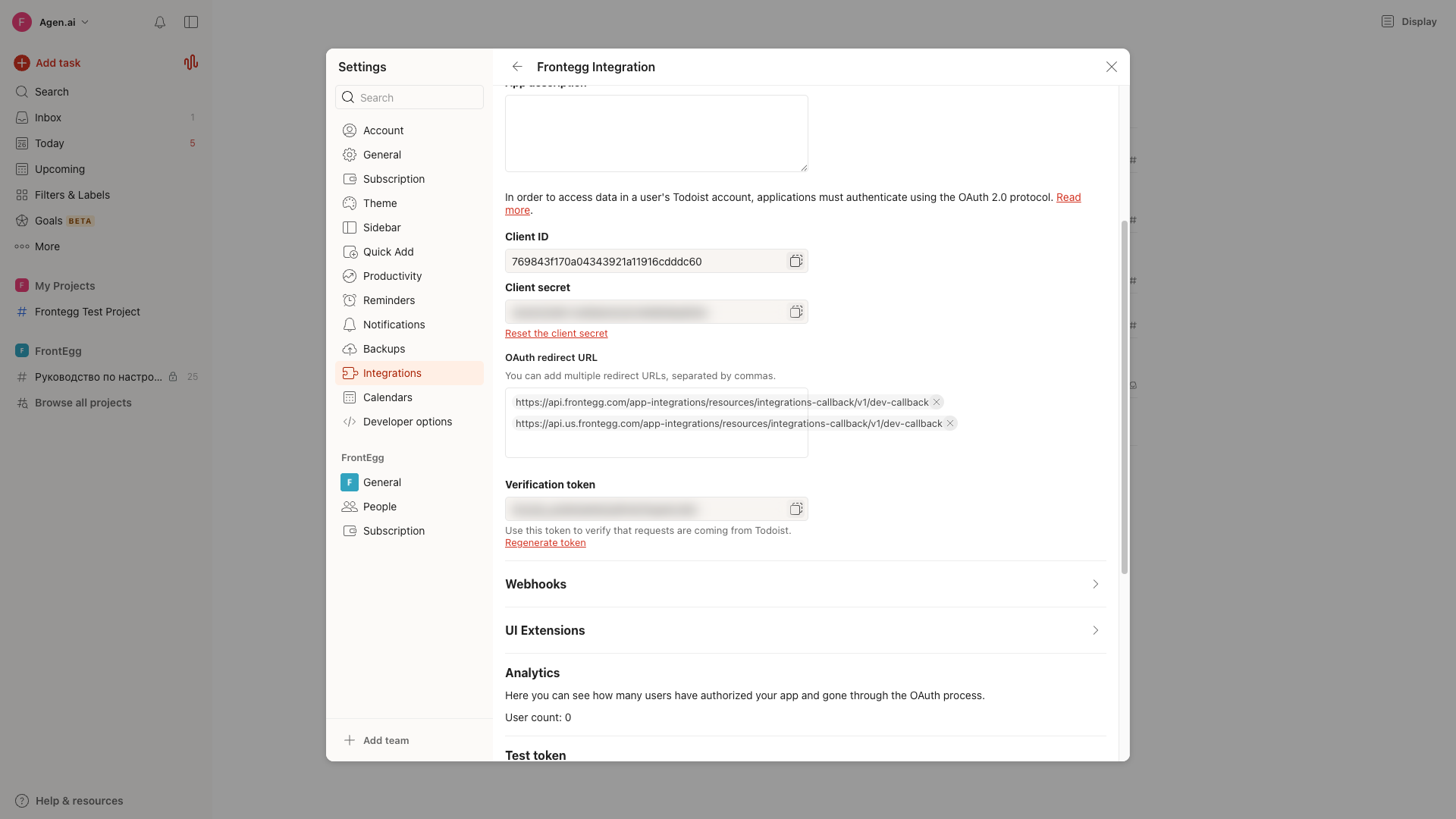
After saving, verify that the redirect URL and the app name are correct. The page should display the saved configuration without the Save/Cancel buttons.
Todoist manages OAuth scopes at the authorization request level rather than through the developer console. The following scopes are available:
| Scope | Description |
|---|---|
data:read | Listing, filtering, and reading tasks, projects, sections, and comments |
data:read_write | Creating, updating, completing, and reopening tasks, creating and updating projects, and adding sections and comments |
data:delete | Deleting tasks (the Delete Task tool) |
project:delete | Deleting projects. No connector tool uses this scope |
Minimum required scopes
Minimum required scopes
For basic functionality, you need: data:read, data:read_write. Add data:delete if your agents should be able to delete tasks.
Once you have obtained your Client ID and Client Secret from the steps above, enter them in the integration configuration page of the Frontegg portal:
- Open the Frontegg portal and navigate to [ENVIRONMENT] → Integrations → Todoist.
- Enter the Client ID and Client Secret in the corresponding fields.
- Select the required scopes.
- Click Save.